On Strange Homecomings
Some words on my relationships with multiple homes, created, lost, and found: New York, Damascus, Michigan, and among my most volatile of homes, the world of diasporic political commitment.

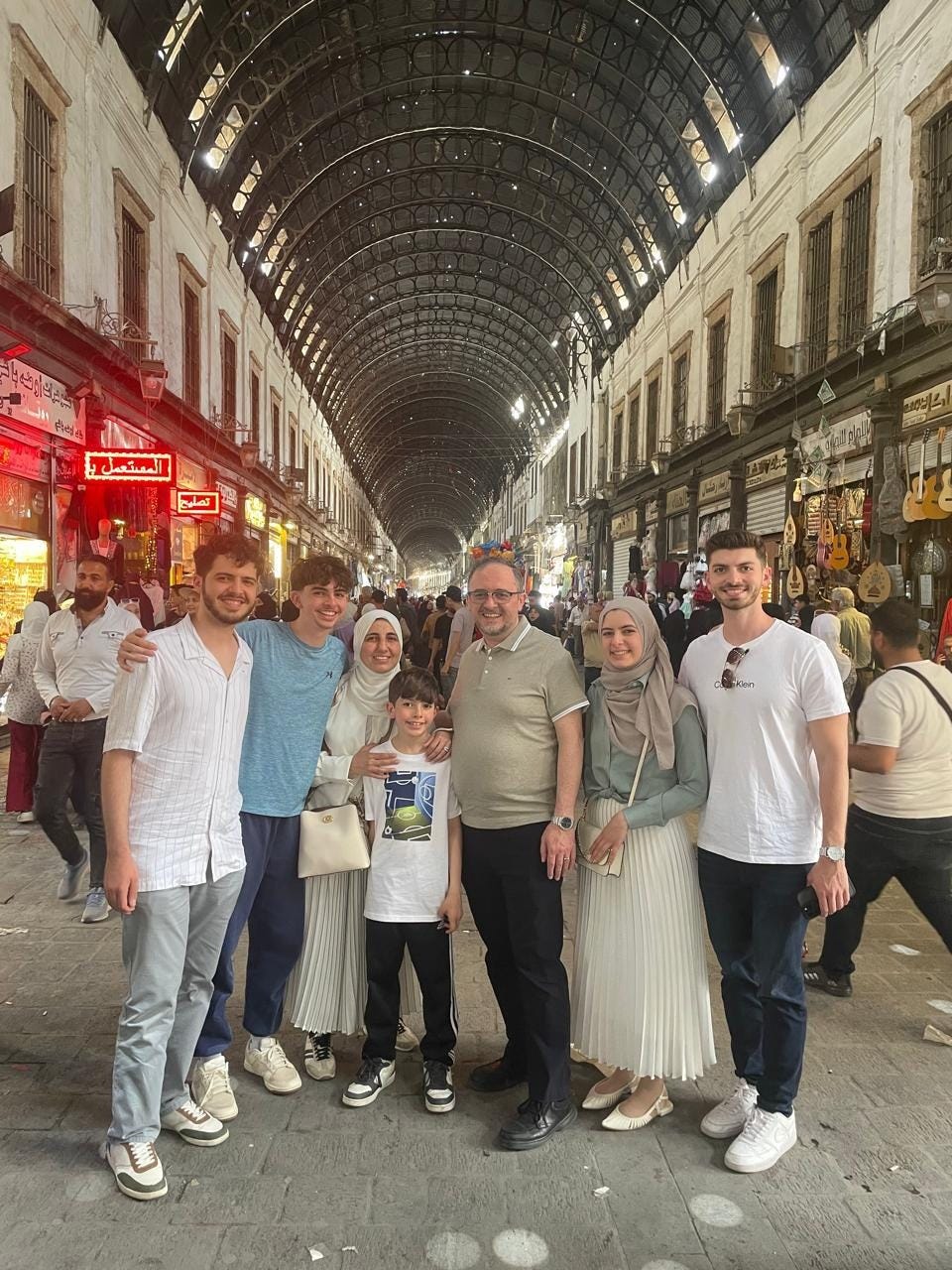
2025, maybe more so than most years of my life, has been a year worth processing through the written word. It’s been a year of multiple strange homecomings: my first visit to Syria in a decade and a half, my first time reconnecting with friends and relatives from what feels like alternative timelines, and my first time living in my parents’ house in Michigan in eight years. I call them “strange” homecomings because they’ve been unexpected, reorienting, in some ways painful, in other ways joyful; above all else, they’ve been deeply transformative.
I started the year in a state of pure disorientation that lasted at least half a year. The culprit of my confusion included what people would typically refer to as a quarter-life crisis, which started for me around November 2024 but escalated significantly on December 8th, 2024 after the collapse of the 55-year Assadist dictatorship in Syria. Those first few months psychically rocked me in a way I would not recover from for months. I shuttled constantly between pure joyous adrenaline, confused delirium, and existential sobs. I remember every person I spoke to, every expression I saw in the first 48 hours: my roommate Abdullah’s stunned look the moment I announced it, my neighbor Omar’s wide-eyed grin when I went to his birthday party coincidentally on the same night, my childhood friend Muhammad and I’s teary congrats on our first video call in the better part of a decade on that same night. Above all else, I remember the intense disorientation I felt plunged into, a kind of unmooring that felt unsettlingly permanent at the time.
I’m writing about the year in my life in the wake of December 8th for a few reasons. I think there is value in processing through documentation, and I expect that I would like to revisit this writing after some time passes. But beyond that, as a lot of my closest friends know very well, it’s been a really raw year—I feel that I basically spent the entirety of it slowly putting pieces of my sense of self back together after it shattered. Over the course of the year, I’ve had to retrace all the major events of my life: the impact of the Syrian revolution and war on my teenage years, moving to the US halfway through high school, my evolving relationships with faith and family, how my college diasporic political ideals developed, what I did with those ideals in the years I lived in New York (especially through the genocide on Gaza), and how I relate to all of it now. Though I write partly as a mode of catharsis, I also write knowing that some of what I will express may be relatable to a reader, likely one that comes from a diasporic background and holds a complicated relationship to “home” that plays out in all of their major life contradictions. That reader is my primary audience for this piece.
I. NEW YORK CITY
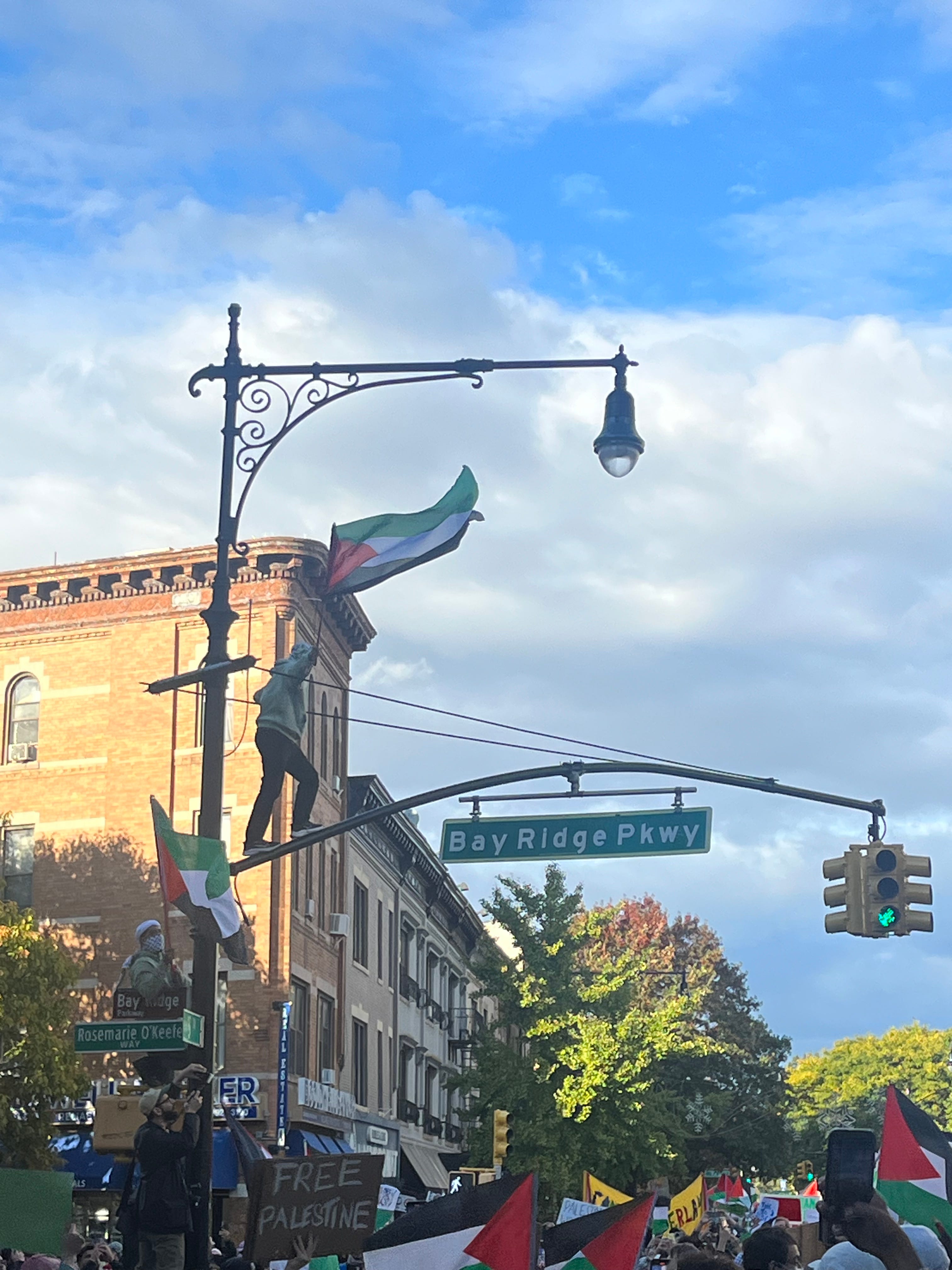
All I can remember from that hazy night was my dad’s calm decisiveness on the phone. “I think it’s time you came home. Send in a resignation letter tomorrow morning, find the closest U-Haul booking you can afford, and start driving to Michigan. Allah Yihmeek.” My father was never one for making decisions on any of his kids’ behalf, much less dictating a course of action for his eldest son. In this case though, he wasn’t alone. A unanimous chorus of close friends strongly recommended an end to my brief chapter in D.C. When all the people you love are barely holding themselves back from taking the reins of your own decision-making, any difficult choice could turn into a no-brainer.
On that 16-hour truck drive from D.C. to New York to Metro-Detroit, all I could feel was disorientation and grief. My negotiation with living in D.C. had more to do with my negotiation with living closer to New York, where I built a life on as stable ground as I felt I could in the city’s relentless instability. D.C., on the other hand, I could care less about. In the month and change that I lived there, I tried forcing myself to tolerate its culture of institutional braggadocio for a job that offered the possibility of contributing to the massive public health needs of my home country, as well as a small but sturdy network of loyal friends nearby. But really, the grief of leaving D.C. was primarily the grief of moving farther out than a train ride away from New York, a city I felt both desperate and devastated to leave.
A friend recently reminded me on the phone an important aspect of why I felt so attached to New York. “You love the city because it’s the first place you chose as your own.” Consciously and unconsciously, I chose New York at countless points in my adult life. The first turning point: my initial visit to the city with my younger brother Abood three years after moving to the U.S., when I first felt pulled by the city’s oft-celebrated and undeniable spell. The second and more consequential encounter took place when I made the easy choice of enrolling into a Masters program I didn’t have to pay for during the pandemic, which served more as an excuse than anything else to turn Brooklyn into a personal refuge. My first two years living in the city could be characterized by an almost childlike sense of bohemian whimsy and rootlessness, weighed against sometimes tastelessly self-serious political commitments that would continuously mature over the years I spent in the city. The memories from those days make me wince almost as often as they send me into fits of nostalgia and laughter.
My relationship with the city fundamentally transformed in late 2023 through my first full-time job out of school as a nonprofit worker at a local environmental justice and housing justice organization in the South Bronx. On paper and more often than not in practice, the job served as the exact kind of antidote to the rootlessness I felt during my first two years in the city. It forced me to zoom in extremely closely to injustice at the city and neighborhood levels. The fact that I took the job only a month before the Israeli genocide on Gaza unfolded juxtaposed violences both local and international. It also meant that I lived and breathed from a mental space of breathless obligation and righteous anger during my first year or so on the job.
I got to know the city more intimately through protest, engaging with aggravating municipal political bureaucracies through my workplace, taking semi-regular long, slow walks, listening to neighborhood elders reminisce for hours, and consuming a slew of NYC local history books. Building that sense of belonging to the city was an active choice. I wanted to resist the narratives around New York being either a transient homeland for the upper & middle class young professional, an unstable but necessary dwelling for the downtrodden, or a comfortably permanent home for the hedge fund financier. The city was, of course, all of those things, but I insisted (and still insist) that it is & that it can be more than all of that.
“The grief of leaving D.C. was primarily the grief of moving farther out than a train ride away from New York, a city I felt both desperate and devastated to leave… My first two years living in the city could be characterized by an almost childlike sense of bohemian whimsy and rootlessness, weighed against sometimes tastelessly self-serious political commitments that would continuously mature over the years I spent in the city. The memories from those days make me wince almost as often as they send me into fits of nostalgia and laughter.”
The choice to make a home out of New York was also consciously made in lieu of having a homeland for myself in Syria, which at that point existed in my mind as a faint memory. A few months into my job I remember telling one of the youth organizers I worked with, “I wish I had a neighborhood and a block whose future I could fight for.” I never felt much of an intimate sense of belonging anywhere I lived before New York — not in Jeddah, not in the suburbs of Detroit, and certainly not in Ann Arbor (despite all the warm memories and friendships I developed in all these locations). The closest feeling to intimate belonging was a passing thought of attachment I remember feeling as a child in Damascus over 15 years ago.
But by the time I was almost four years into living in the city, I felt I had gotten closer to loving a place strongly enough to want to fight for its future than I ever had. There was just so much to love about my experiences living in outer-borough New York specifically. I got used to hearing the Dominican deli worker on the block calling out “Hello Syria!” to me during my lunch breaks, the sound of bachata blasting on the street in the summers, the building super’s occasional chatter about his marital problems. I had assembled a motley crew of close friends and acquaintances who taught me to love geographies completely alien to me, between Puerto Rico, Haiti, India, Mexico, Colombia, the Philippines, Korea, and West Africa. And I slowly learned the terrains of political struggle in their lives, between displacement pressures, educational disparities, and horrific public health outcomes in their neighborhoods, and dictatorships, oligarchies, and occupations in their homelands. It augmented and transformed a sense of political commitment I developed towards Syria over my years away in Jeddah and in the US—but by 2024, those commitments largely remained grounded in local political struggles, in organizing for Palestine, and in a relegation of Syria to the realm of abstract political and cultural imagination.
All of that changed when the rug was swept from under me on December 8th, 2024, and I could suddenly visit the country again for the first time in over 15 years.
II. DAMASCUS
A kid on a bike stopped rolling past us in Al-Mazzeh neighborhood in Damascus to announce: “Are you looking for Binayet Beyt Sbay’i (the Alsubees’ building)? You’re standing in front of it.” We were visiting my grandparents’ house in a building packed with nothing but relatives on my dad’s side, and were a little hesitant on whether the correct building was through the doorway right in front of us or the identical one right next door. After hearing the child’s words, we all stood there stunned for a few seconds, partly taking in our distance over the years and what it meant to return, and partly pondering how remarkable it is that a random boy would have the encyclopedic knowledge of his own neighborhood to point out exactly which building was my family’s. I broke the silence: “We are ourselves Alsubees. We haven’t been able to visit our family members in 15 years.” The kid responded “Alhamdulilah ‘assalameh, welcome back home,” before whisking away.
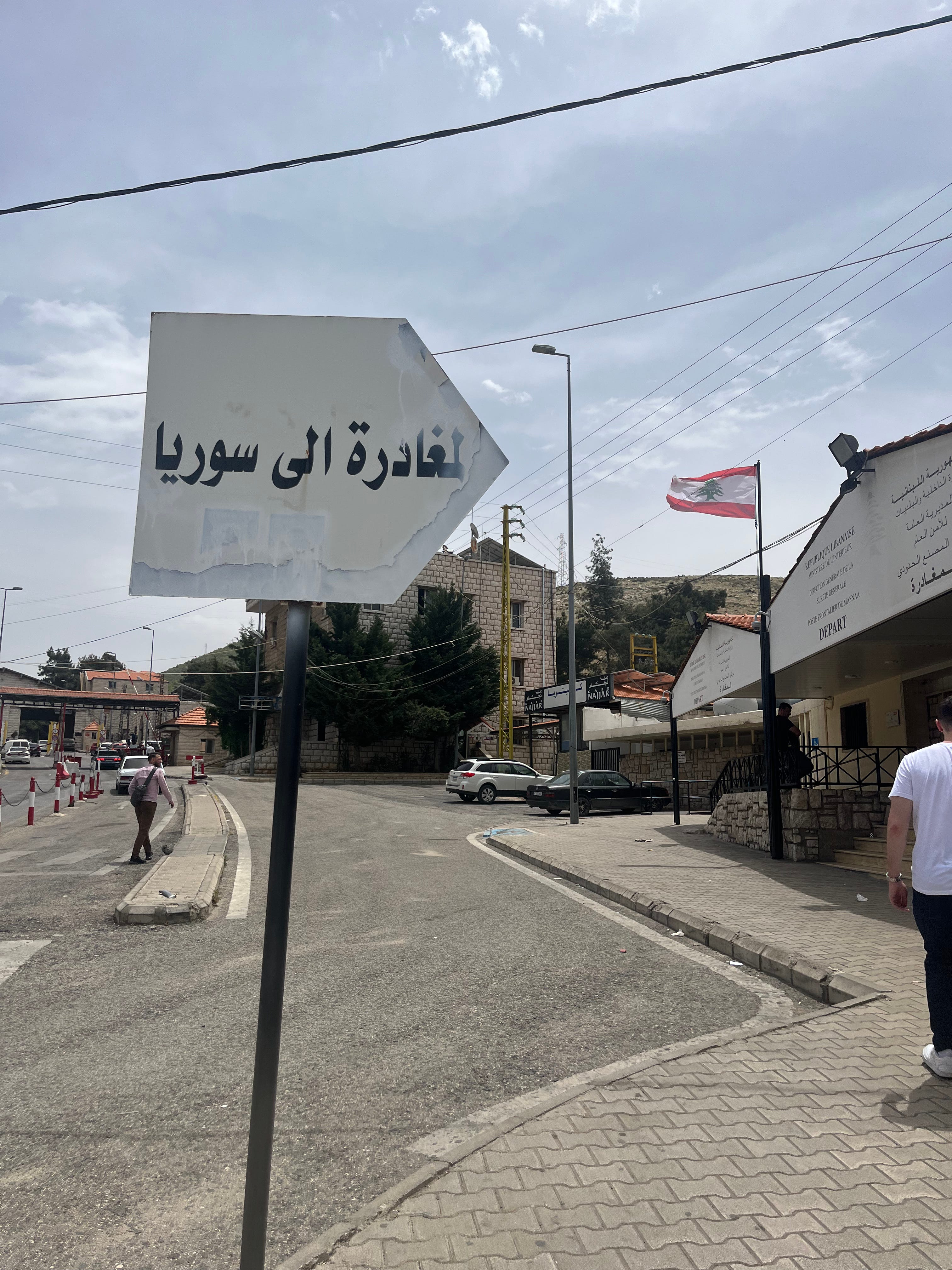
My first visit back to Syria after the 2011 revolution and almost 15 years of war was a 36 hour incidental trip—we were mainly going to Beirut (also my first time) for my younger brother Abood’s engagement. The trip was in May of 2025, a few days after my U-Haul trip back to Michigan and only 5 months after the end of the Assadist era in Syria, and it was equal parts a disorienting and hopeful time in the lives of most Syrians I know.
For those of us who had been living in exile from our homeland, none of us expected that we would suddenly have to rethink our sense of belonging. Some of us chose to belong to the countries we departed to (though many of us did not have the option of belonging because of refugee status and sociopolitical structures of discrimination against Syrian refugees), and some of us, as was my case, held the privilege of building a sense of belonging but opted instead to stay on the move. In any case, the majority of Syrians in exile that I know were resolved to the depressing reality that returning to Syria was an impossibility, so much so that we hardly ever thought of it anymore. That May trip to Beirut and Damascus was the first chance I had to peer past the doors of impossibility.
“The choice to make a home out of New York was also consciously made in lieu of having a homeland for myself in Syria, which at that point existed in my mind as a faint memory. A few months into my job I remember telling one of the youth organizers I worked with, ‘I wish I had a neighborhood and a block whose future I could fight for.’”
The 2 hour roadtrip from Beirut across the border to Damascus felt as though we were traversing worlds. Beirut certainly has its own spell and humor, the mountainous city’s foliage, concrete, and pictured rocks brushing up caustically against the Mediterranean, in all of her harsh griefs and bitter ironies. But as we crossed the mountain range bordering the two cities, I started to take in the toll the last 15 years took on Damascus, ironically, by how little it seemed to have changed. Beirut seemed to bear its burdens of economic blight and warfare through an unusual metamorphosis, a kind of effortless spontaneity I find admirable. But Damascus seemed to bear its suffering by desperately reeling its people in, holding strong onto its centuries of heritage, and out of necessity, even preserving its scrap metals and broken electrical devices that people seem to find all kinds of creative uses for. The only immediately perceivable difference between the Damascus of my memory, and the Damascus of my brief 2025 visit, was found in the knowledge that there were nearby neighborhoods that were completely leveled to the ground (neighborhoods we did not have the chance to visit this time), and all the heavy psychological weight everyone seemed to have accumulated over the years of war. In a sense, my first grief coming back home was centered in how dramatically I had changed relative to the city I grew up loving.
There were also joys involved in witnessing the city’s uncanny stasis—the long hugs with the relatives I never thought I’d ever see again, the faces I never realized I’d forgotten, the neighborhoods that turned the faint images in my head back into vibrant color. Above all else, I’ll never forget visiting my grandparents’ old house, clearing the dust on pieces of furniture and clothing completely unmoved from where they were 15 years ago. I could not but feel gratitude for the country’s perseverance, for the unimaginable sacrifices of all the Syrians I never got to meet, for the fact that I lived long enough to pay witness to it all again, and for the hope that I will be back time and time again, ready to rebuild my relationship with the country, and eventually come to learn exactly how I will contribute to its necessary healing.
“For those of us who had been living in exile from our homeland, none of us expected that we would suddenly have to rethink our sense of belonging…. The majority of Syrians in exile that I know were resolved enough to the depressing reality that returning to Syria was an impossibility, so much so that we hardly ever thought of it anymore. That May trip to Beirut and Damascus was the first chance I had to peer past the doors of impossibility.”
But then there was also an anger so overwhelming it seemed to go everywhere at once. I felt blind rage towards all the murderers who made the price of this joy too devastating to bear—the ones who got away with shelling entire towns and neighborhoods, displacing bloodlines, jailing our brightest youth, torturing them & their families for decades, if not completely disappearing them, and leaving the country in a state of infrastructural and social disrepair so dramatic that most Syrians’ political horizons today are completely contingent on projects of rebuilding and transitional justice (both of which are absolutely critical, and at the same time depending on how they are approached, could potentially lend themselves to exploitative or retributive politics that might set us back even farther in the long run, if not potentially steer us into another brutal civil war). That is to say nothing of the fact that most Syrians’ personal horizons remain grounded in finding the first flight out of Syria to live a more dignified life elsewhere.
Setting aside the vast list of states and militias responsible for all the heartbreak and bloodshed under Assad’s Syria, there is also the anger I hold towards the nastiness that the whole world seems to reserves specifically for Syrians, seemingly outdone only by the nastiness Syrians themselves reserve for other Syrians. It became easier after the fall of Assad to tune out political discourse on Syria that does not take its point of departure to be the horrific violence and devastation inflicted onto Syrians primarily by Assad, Russia, and the Axis coalition, discourse that seems to treat Syria today with no understanding whatsoever of any of the country’s local realities and what it continues to endure as a consequence of the war and 55 years of military dictatorship.
But it became much harder to tune out the nastiness Syrians hold towards each other—the sometimes rabid sectarianism; the complete neglect if not explicit justification of violence unfolding on the coast and in Suweyda; and the altogether far too polarized political scene that holds no room for any back and forth whatsoever, let alone room for grounding in a shared political project of national uplift despite ideological difference. Syrians, ourselves in a dramatic silo from global political discourse, seem to be more siloed from each other than ever, our political, moral, and ethical compasses circumscribed not only by sect, ethnicity, locale, class, tribe, and geographic displacement, but also by immediate political demands arising from radically different, sometimes hyper-local circumstances, like needing to find a long-lost loved one (or at the very least evidence of their existence) in a mass grave or an abandoned prison, seeking justice against war criminals and Captagon traffickers living scot free in their very same neighborhoods, fighting back ongoing Israeli encroachment, occupation, harassment, and bombing, barely holding together a family from extreme poverty or the threat of violence exploding out of local sectarian grievances, and so on. It remains difficult to stay grounded in Syria-related work and discourse, as urgent as it is, without occasionally sinking into a state of anger & despair, losing sight of the broad political horizons charted in 2011 that are still beyond our reach as a people despite the leaps of progress made since December 2024.1
“The only immediately perceivable difference between the Damascus of my memory, and the Damascus of my brief 2025 visit, was in the knowledge that there were nearby neighborhoods that were completely leveled to the ground, and all the heavy psychological weight everyone seemed to have accumulated over the years of war. In a sense, my first grief coming back home was centered on how dramatically I had changed relative to the city I grew up loving.”
As I cautiously and sometimes quietly re-engaged with all the charged emotions pertaining to Syria, especially after my visit, I realized that I was also doing a little bit of psychic re-wiring. I was no longer discussing the political situation in parts of Syria I felt severely removed from. I started reconnecting with and hearing from friends who revisited their homes in Homs, Aleppo, Hama, Lattakia, Deir Ezzor, Eastern Ghouta, Daraa, and some of their nearby villages, who described the current economic and social circumstances in all their locales. Many of these areas, which I still have yet to visit in my life, were areas I read about in these years of war and exile. They were part of a country—a cause—that receded further and further into abstraction, the longer the war went on, and the larger our exile grew.
Over the months since December 2024, I came to many realizations about what being away from Syria meant for my relationship with myself, my homeland, and my moral compass. I found myself slowly re-familiarizing myself with the sensibilities of my Damascene family members, that جوا السور politeness and religiosity that strikes a delicate balance between warmth and excess, invariably cloaking unspoken perceptions and juicy rumors. (It’s a sensibility I always struggled with, and still do, but at one point felt that I’d mastered the ability to maneuver in a way that almost allowed me to enjoy it). I reconnected with friends and family I haven’t spoken to in over a decade and a half in some cases, my headspace scuttling away from the occasionally insufferable political environments I spent some time around in New York and moving towards a socialization considerably less demanding & full of the easygoing, sardonic humor you’ll find in any conversation with most Syrians. It was a socialization I used to occupy very easily, but at this point required some quick re-familiarization.
All of this psychological whiplash allowed me to realize that by the time there were 15 years of difference between my most recent trip to Syria and the previous one, I had almost thoroughly recoded my relationship with my homeland to bring the political and the aesthetic to the forefront, and to marginalize the personal and the experiential—in short, to abstract myself from the most organically contradictory, mundanely beautiful, and devastatingly alive aspects of belonging to Syria. And my suspicion is that any young diasporic child whose political commitments form in a home away from home does something similar, consciously and unconsciously.
At any rate, I felt the work ahead of me was to rebuild my relationship with my country, my relationship with my own self, to forge it out of honesty, love, and genuine connection, to reground the political in the practical and not simply in the easy, idealistic posture of the exilic cause-bearer, to create new memories, jokes, and ways of relating to different neighborhoods and streets—in short, to resist abstraction, both of myself and of my country. But first, I had to deal with the life waiting for me back in Michigan.
III. MICHIGAN
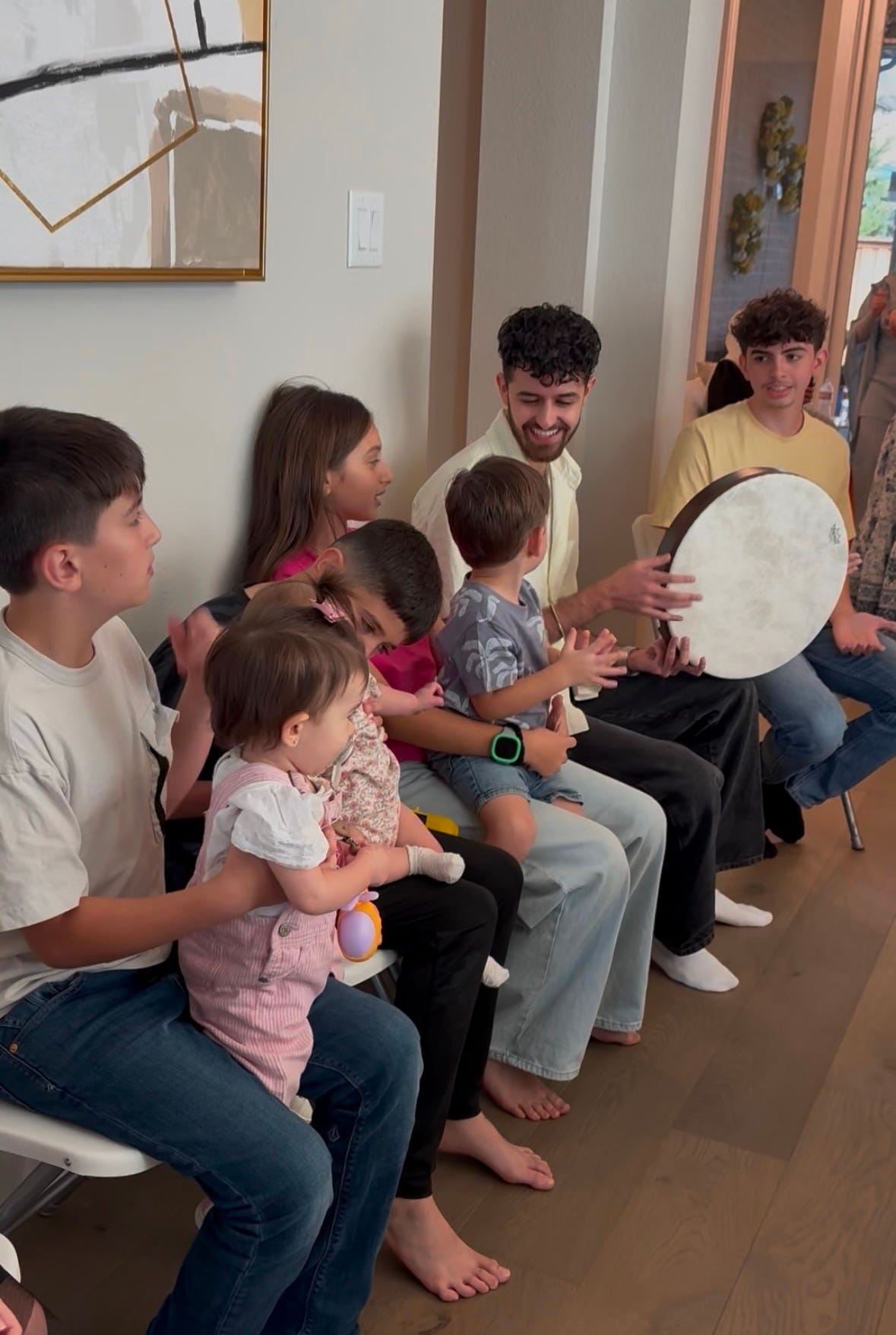
“Allah yjbor bikhatrak (May God bring joy into your life),” an elder Syrian neighbor said to me as we walked out of an ICE appointment regarding his family’s expired temporary protected status. The appointment was about 5 months after the truck drive from DC to New York to Michigan, and by then I had gotten much more settled into my family home. I joined ‘Ammo and his family in my capacity as an Arabic-English translator after having recently picked up a job as a paralegal at a nearby immigration law firm. As far as ICE interactions are concerned, especially during this Trump administration, the appointment could have gone a lot worse. Yet in the moment, I thought about what it would have been like for the family to go unaccompanied, unable to explain the logistics of their sudden precarity to a plainclothes ICE officer whose calm demeanor felt aggressively mismatched with his threatening choice of words. Before that ICE visit, my life had of course been dramatically upended over the course of the year—yet it was one of many moments since I moved back to Michigan where I knew that I was exactly where I needed and wanted to be.
It certainly did not feel that way 6 months ago after that fateful U-Haul booking. For the first two months I was here, especially after my trip to Syria left me even more emotionally stunned, I did all I could to keep myself from collapsing into a pit of aggressive self-blame and feelings of failure. Here I was, 26-years-old, living back in my parents’ house after eight years of wandering, struggling to make out some semblance of a clear professional horizon, all while dealing with a heaping second helping of the canonical quarter-life crisis. To make matters worse, all of the accumulated (and more or less entirely manufactured) guilt and shame I felt for being away from Syria and away from my family in Michigan hit me all at once. I relentlessly attacked myself for having changed over the years. In some ways, returning back to the place I moved to when I first arrived in the US felt as though I was putting on old shoes that no longer fit me, and then self-flagellating about the fact that they didn’t.
In most ways though, moving back was an extremely fortunate decision. The fact that my family took me back in and I didn’t have to worry about the immediacy of New York/DC rent and bills gave me the time and space to work through this dense web of intense emotions. It also forced me to retrace my steps. My first month after coming back to Michigan transported me viscerally to my earliest days in the US. I remembered (and re-felt) the intense isolation, the fact that I only had a handful of new friends in place of the decade of established friendships I had in Jeddah, where I grew up. I resented those teenage feelings of isolation as much as I resented reliving them involuntarily as a 26 year old.
Nevertheless, I had no option but to remember, and remembering proved quite personally productive. Specifically, I kept coming back to how I was immediately thrust into political intensity, having arrived with a massive Syrian family (10 of us in total) as the oldest child right before the start of the first Trump administration at the height of the Syrian refugee crisis.
“All of this psychological whiplash allowed me to realize that by the time there were 15 years of difference between my most recent trip to Syria and the previous one, I had almost thoroughly recoded my relationship with my homeland to bring the political and the aesthetic to the forefront, and to marginalize the personal and the experiential—in short, to abstract myself from the most organically contradictory, mundanely beautiful, and devastatingly alive aspects of belonging to Syria. And my suspicion is that any young diasporic child whose political commitments form in a home away from home does something similar, consciously and unconsciously.”
Admittedly, my relationship with the Syrian revolution and struggle had started to dim by then. I had lived through the intense early excitements of the Arab Spring disrupting my family’s plan to move to Damascus back in 2011. At the time, I assumed the disruption would be temporary, since it appeared to my naïve 12-year-old self that the Revolution would immediately prevail, if anything because the videos I saw of what appeared to be millions taking to the streets of Syria’s major cities indicated a sheer popularity I could not wrap my head around.
Instead of celebrating a quick victory however, by 2012, I had already witnessed some of the most horrifying images of collective human punishment I’d ever seen in my life—videos of children’s tortured and mutilated bodies, photos of entire neighborhoods in Homs bombed to the ground, and countless stories of survival in the face of displacement, siege, and merciless massacres. The cruelty in the media I consumed was as unimaginable as were the feats of bravery I saw in the names and voices etched into my child brain, those of Abdelbaset Saroot, Hamza Al-Khatib, Bassel Shehadeh, Ghiath Matar, Fadwa Suleyman, Razan Zaitouneh, Ibrahim Qashoush, Raed Fares, May Skaff… the list of martyrs only grew with every chemical weapons attack, massacre, kidnapping, and assassination over the years.
And of course, beyond the emotional toll of paying distant witness to violence, the Revolution and war’s immediate impact on my personal life was also quite significant—in early 2012, my grandparents and disabled aunt moved out of Damascus into our Jeddah household, and they’ve lived with us ever since. Of course this was not an easy adjustment for anyone, including especially my grandparents themselves, who did not know they were leaving their home for over a decade and a half when they left it. Needless to say, by the time 2015 rolled around and we were gearing up to move to the US, thinking about Syria became such a source of distress for me that all I wanted was what I imagined to be a “normal” teenager’s life.
Moving to Michigan at the time that I did put a wrinkle in the desire for normalcy—though when I think about it, that was also not necessarily an inevitability. I met more Middle Eastern people and Muslims in Michigan than I expected I would, and saw a whole range of ways of relating to diasporic conditions: the wide spectrum between complete estrangement from one’s roots in the name of assimilation, to living in an insulated ethnic enclave governed entirely by imported cultural logics rendered more severely conservative than anything back home. This spectrum felt a lot more complicated, maybe even richer, to me than the set of expectations and choices associated with my previous life in Jeddah. It certainly carried a lot more existential pondering than the simple set of expectations I dealt with previously, where I was surrounded entirely by other Sunni Muslim Arabs. Now, I had to decide where I wanted to fit in this spectrum of diasporic belonging in a place I did not remotely understand yet.
“All of the accumulated guilt and shame I felt for being away from Syria and away from my family in Michigan hit me all at once, and I relentlessly attacked myself for having changed over the years. In some ways, returning back to the place I moved to when I first arrived to the US felt as though I was putting on old shoes that no longer fit me, and then self-flagellating about the fact that they didn’t.”
By the time I went to college, political work and thought started becoming the playground on which I negotiated my sense of self as a newcomer to the US. My rationale went: I was lucky enough to already hold U.S. citizenship because I was born in Detroit before my family moved to Jeddah, and now that I was in a foreign land, I felt that the survivor’s guilt of living comfortably in the US as a Syrian demanded that I do something with it in such times of devastation. I also admittedly felt insecure that I was not as politically knowledgeable as most of the people I met, due to the Middle Eastern autocratic miseducation I received.
My two years of American high school, four years of college, and two years of graduate school gave me enough space to gradually develop a political compass through learning, relationship-building, and grassroots organizing. Seeking political knowledge through voracious reading became not only a means of understanding the complicated society I found myself in, but also of making sense of my moral obligations and my place in the world (not to mention an unexpected source of great pleasure). I decided I would study History, and as I did so over six years of my life between Ann Arbor and New York City, I shuffled through various clumsy political descriptors ranging between Modernist Islamism, Democratic Socialism, Decolonial Anarchism, Third Worldist Marxism, and various eclectic mishmashes of other political traditions. (I would add that this ordeal of sifting through political identity markers threatened, at times, to become an unnecessary indulgence in dogmatic self-fashioning too far removed from any struggle to hold any meaning.) Eventually I felt disturbed both by my inability to fit what I learned from my studies into neat labels, and by the ways in which ideologues seemed to treat themselves, the people in their lives, and the struggles they claimed to represent, that I decided I would quietly retreat to the books, to direct and quiet political work and service, and speak up only on matters I felt I understood well enough.
At any rate, by the time I returned to Michigan from New York City, and after having lived in the US for a total of nine years, political work and discourse had become central to my sense of identity and how I attempted to create home away from home. I went from an entirely politically illiterate Syrian Sunni Muslim teenager who simply wanted a better future for himself and his home country, to a highly politicized 26-year-old passionate about understanding contemporary political and economic conditions, well-versed in the national landscape of Muslim and Middle Eastern political spaces and institutions, and well-read enough on the histories of the Middle East and North Africa, Europe, and the Americas to articulate my own political ideas on local, national, and international levels. Even my own understanding of the Syrian Revolution matured significantly through a deeper look at regional and global history and politics—I felt as keen on learning from its adherents’ sacrifices as I was intent on studying its contradictions.
“When I first arrived to the US, I met more Middle Eastern people and Muslims in Michigan than I expected I would, and saw a whole range of ways of relating to diasporic conditions: the wide spectrum between complete estrangement from one’s roots in the name of assimilation, to living in an insulated ethnic enclave governed entirely by imported cultural logics rendered more severely conservative than anything back home. This spectrum felt a lot more complicated, maybe even richer, to me than the set of expectations and choices associated with my previous life in Jeddah.”
Before December 8th, 2024, I had assumed that my own sense of self had solidified, that all my early immigrant woes had evaporated through my nine years of accumulated knowledge and experience in the U.S. And yet here I was back in my parents’ home in 2025, my tenth year in the US, feeling almost as confused and isolated as I did on my first, entirely unable to wrap my head around the rapid developments in Syria, and altogether uncertain about where my life was headed. All I knew was that I needed more practical, solid grounds for my life, even for whatever political and social work I was to involve myself in after I left New York.
Trying my best not to succumb to the guilt, shame, and depression associated with not seeing any clear professional or even sometimes existential horizons for myself at 26, I carried myself to an internship at an immigration law firm run by the attorney who did my grandparents’ papers. I found in the work, which eventually turned into a full-time position, a sense of grounding through direct service, a source of intellectual stimulation, and eventually, a means of providing support to Syrian friends, family, and acquaintances to stay united with their families after long years of living away from home. I also located a longer professional horizon in pursuing a public interest legal career, supporting immigrant families and institutions in navigating complex and violent legal infrastructures not built for their flourishing or for the flourishing of their natural and built environments here and in their home countries.
Today as my time back in Michigan inches closer to a year, I can’t say that I’ve found the answers to all my existential, moral, and political questions, nor do I feel that some of the questions I ask of myself and of the world are ones that ought to find resolution in this life at all. But, at the very least, I’ve found myself undoing the poor foundation I built for my own prosperity and growth, finding much more solid existential grounding in the accumulated circumstances of my life that stretch far beyond my years living as a diasporic Syrian in the U.S. It took the liberation of Syria, the sudden shattering of my invented sense of self, and my insistence on carrying out my local responsibilities and obligations to family and to my Syrian, Arab, and Muslim communities here to find that stable ground.
IV. HOME
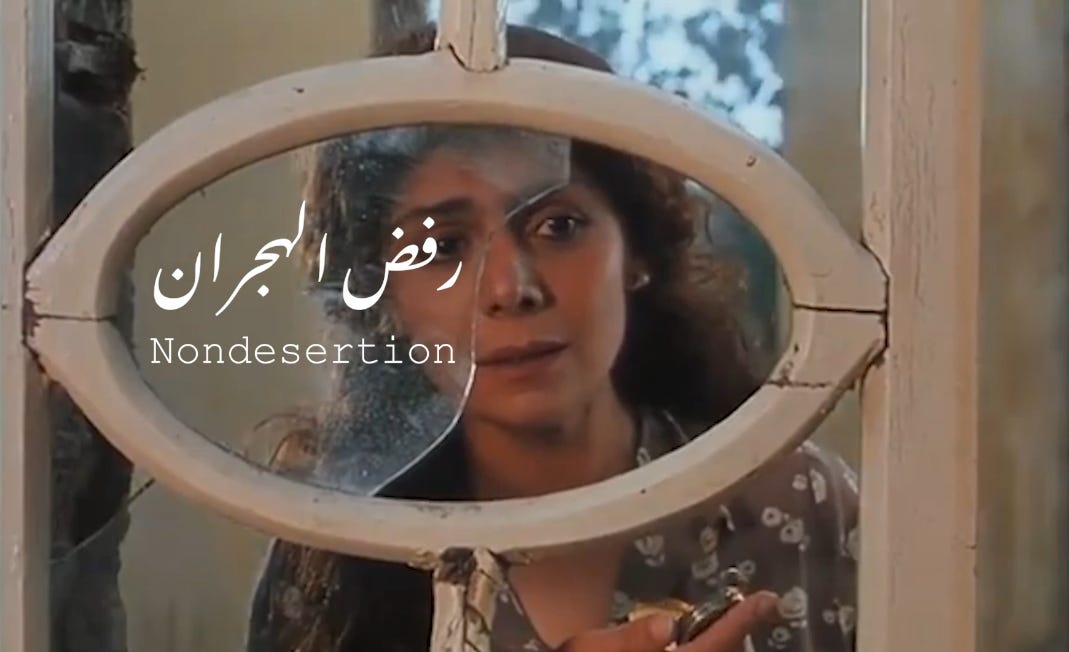
While I was in New York, I worked on and finished my fourth documentary short film, which I decided to call “Nondesertion.” The title is an interpretive translation of a phrase lifted from a song my cousin wrote while she and her family packed their bags and moved to Turkey along with almost 4 million other Syrians (the Arabic title being رفض الهجران from the song titled بعدي عنك). I used to listen to the song most often during the years 2013-2015 with my close Syrian friends in Jeddah. The prevailing sentiment of our act of collective listening was a plea and reminder not to forget who we are or where we come from no matter where in the world the Syrian diaspora flings us. When I repurposed the phrase for my film, I was reprogramming it to focus on the memories surrounding the Revolution itself, as well as Syrian historical memory more broadly. I wanted to underline the importance of remembering during times of painful forgetting and loss of political horizons implied by an Assadist victory. Yet, after the unexpected fall of Assad and his criminal gangs’ dictatorial hold on Syria, it seemed I had done as much forgetting as I did remembrance, despite my best intentions.
2025 most acutely taught me that remembering and forgetting are vexing, ongoing processes. They evolve as we evolve, as our social world transforms, as we ask new questions of ourselves, of the lives we want to lead, and of the world we want to bequeath to our children. Through my early adulthood in diaspora, the equal parts rich and painful world of political labor became central to my sense of self. My political personhood became an anchor, a compass, a volatile home of sorts. When the worlds I once knew disappeared suddenly, I was in need of such invented homes so as not to lose myself to the maddening wilderness of alienation in the West. I doubt there are any immigrants (or even children of immigrants) who are not forced to consciously and unconsciously create their own sense of home, no matter how radically we all differ in the ways we choose to construct those homes.
Though I may have already been aware of some of this, I don’t believe I reckoned with the fact that some homes are more built to last than others. At 26, I have found that a home built purely on the all-too-serious foundation of worldly political responsibility is more fragile than its righteous appearances imply. Beneath its upright veneer of nobility often lies anxiety, insecurity, and loss… grief so deep that reckoning with it all at once can threaten to drive one back to that same maddening wilderness.2 (2)
Despite what may appear to be a somewhat ambivalent or even slightly disparaging tone throughout the course of this writing, I am not denigrating the political struggles and efforts of politicized diasporic youth who work from a place of deep love and responsibility, whose errors seem to be traced back to their existential conditions of displacement and exile. (I count myself among them after all, and I refuse to let myself hate any version of Basil). These are young people trying their best to resist centuries-long legacies of violence who are often indicted for their weak holds on languages they were not raised with and their lack of grounding in a geography they were robbed of the opportunity to intimately love and absorb. As poorly as they may occasionally treat their interpersonal responsibilities or the people on whose behalf they speak, they are low-hanging fruit who are more often than not flung with bricks by people with even more fragile glass houses harboring deeper insecurities, anxieties, and pains.
The more egregious mistakes that diaspora youth make, to me, lie in the insistent refusal to accept our very condition, to continuously abstract ourselves in the name of youthful revolutionary fervor and righteous cause-bearing. When political moralizing forgets the soil it arises from, who and what it speaks to, as well as who and what it fundamentally cannot speak to, it ceases to be anything but an aesthetic indulgence at best. I completely reject the idea that moral and ethical responsibility should start and stop in the realm of ideological discourse or even in heated discussions around political strategy & goals. Responsibility cannot exist beyond the revolving relationships one holds with oneself—and in the face of an easier, smarmier, more self-aggrandizing moral impetus, diaspora kids have the tougher, but infinitely more rewarding option of forgiving ourselves for our distance, embracing our own humanity, and continuing to do the hard, serious work implied by our responsibilities to our people abroad while perhaps staying humbler and quieter (and indulging in the joys of being who we are in all of our strange multicultural affections, too). It may be the only way we refrain from turning our political and moral prerogatives “here” towards our people “there” into a clumsy cudgel we use in a self-purification ritual against ourselves, vainly clamoring to atone for the cardinal sin of being diasporic. The least we can say about such rituals is that they are purely an endeavor of narcissistic distraction in some of the bloodiest of times, where distractions of any nature can scarcely be afforded.
Lest I get preachy about all of this, I remember that navigating my own personal, political, moral, and familial responsibilities has always been a clumsy and non-linear process. It’s true I’ve resolved myself to trying to stay clear of social environments dictated by the logic of the diasporic purity contest (by which I mean any environment where the principle hierarchies of engagement revolve around how strong one’s Arabic is, how religious one presents, how anti-Western one’s political and cultural posture appears, and so on). But seeing that we are all human beings clumsily navigating our awkward condition of owning our responsibilities in spite of distance, it’s expected that any sort of social or political collectivity will require tolerance of human mistakes and potentially grating sensibilities, especially those arising from previous versions of oneself. All I can hope is that no one has to endure as rude an existential comeuppance about how they have let their ideals become a substitute for their unapologetic humanity as I did.
Luckily, I had enough established relationships with friends and family that I could lean on when my life, my horizons, and my sense of identity shattered in 2025. My friends (who know who they are very well) facilitated a turbulent move out of New York and kept me floating in the haziest and roughest of days; my parents taught me new dimensions to love and care I didn’t think I would ever see; my younger siblings carried me on their shoulders in ways I could have never anticipated. I also leaned on lessons from the foundation of faith and resilience I built and absorbed from my childhood in Jeddah living through the early days of the war in Syria. I now feel that I’m not only back on my own feet again, but I am more myself than I ever thought I could be, because I’m able to own my relationships to every place I have lived in and loved, and all the selves I have been, from Jeddah and Damascus to Michigan and New York.
I end with song lyrics from an unexpected foil for “Nondesertion,” a song called “Going Home” by the late Leonard Cohen. Morbidly enough, Leonard Cohen wrote the song about his own death about 5 years before he passed away. Though he had death in mind, I think of the song in times full of life and serenity, when I feel I can confidently and quietly embrace myself, in all my limitations and strengths. Today I live with the unforeseen blessing of being able to visit Syria on a yearly basis, perhaps even eventually moving back there one day. That blessing entails a newer set of responsibilities to be navigated that will most certainly challenge me in ways I can’t anticipate. I am hoping to honor that blessing by continuing to build myself up after I fall, continuing to ask difficult questions of myself, continuing to fight for what I believe in despite the costs associated with it, continuing to care for the people and places I love in spite of distance, and continuing to be me. I’m excited to be going home.
He wants to write a love song
An anthem of forgiving
A manual for living
With defeat
A cry above the suffering
A sacrifice recovering
But that isn’t what I need him
To complete
I want him to be certain
That he doesn’t have a burden
That he doesn’t need a vision
That he only has permission
To do my instant bidding which is to
Say what I have told him to repeat
Going home without my sorrow
Going home sometime tomorrow
Going home to where it’s better than before
Going home without my burden
Going home behind the curtain
Going home without the costume that I wore”
- Leonard Cohen
To read more on what I consider those horizons and challenges to be, see this post, as well as its English translation.
I am a believer in rejecting our narrow cultural identitarian frames, the self-enclosed homes of ethnic and religious identities in diaspora, both for political and human purposes. Yet I do have some caveats to that rule. Of course I am highly influenced by, and in agreement with, writers such as Edward Said, Édouard Glissant, Dionne Brand, James Baldwin, Adorno and others who find deep moral-ethical value in the political dynamism of living in their various painful exiles, keeping one’s responsibilities and sensibilities outside of the narrow and sometimes violent frames of belonging and identification. But in the same token, I am as suspicious of the moral trappings of identity politics as I am of complete and utter non-identification, of entirely losing a notion of selfhood, of suffocating righteousness and of the sometimes spiritually-bereft aesthetic indulgences of a diasporic political imagination. I find myself aggressively opposed to extracting oneself from the local, personal, and experiential, only making it easier to make a habit out of romanticizing others and neglecting their contradictions, cleaving oneself from the joys and responsibilities of love and friendship. I now prefer a frame of identification that is quieter, looser, more grounded, honest, responsible, and fun.
Thanks for sharing this glimpse of your life as a “diaspora kid”, as another flavor of that same thing your definition of returning to home helped me further refine my own interpretation of what it means to go back home. Mashallah, and good luck with your future endeavors and giving other perspectives.
Salam Basil! Such poignant writing mashallah. It feels like you gave readers a glimpse into your soul. While I got lost in some paragraphs, the emotion you convey shines through. I thought I was the only one who, along with the elation of Syria’s newfound liberty, also reeled for weeks afterward. It was confusing to think of the could-have-beens and where-am-I’s and what-little-I-have-done. As Ahmad elAhmad, the Bondi hero pithily said, “I deserve this?”. I missed coming of age in my lands, missed seeing my grandpa before he passed, may Allah have mercy on his soul. Alhamdulilah for Allah’s plan. I have lived and moved many times in my life, in many of the places you’ve mentioned here, and that has only strengthened the idea of a Muslim is a traveler in this dunya. I can only hope my roots take hold in the soil of Jannah more than anywhere else. May Allah write the best for you, brother Basil, and grant you and your beautiful family happiness and contentment in this life and the next.